






The frantic glow of a laptop screen at 3:00 AM is a sight far too familiar to undergraduate students worldwide. We’ve all been there—trying to synthesize weeks of lectures into a coherent argument while the clock ticks mercilessly toward a submission portal closing. This “last-minute crash” isn’t just a rite of passage; it’s a symptom of a fragmented workflow.
In an era where our pockets hold more computing power than the systems that landed humans on the moon, relying on caffeine and sheer panic is a choice, not a necessity. By adopting a tech-first approach, you can transform the way you handle academic pressure.
The journey from a blank document to a polished submission begins with understanding the technical requirements of your task. Many students dive into writing without a clear map, leading to “fluff” or incomplete arguments. Before you even type your first sentence, you need to establish the boundaries of your research.
Utilizing digital planning tools helps you visualize the structure of your work. For instance, knowing exactly how long is an essay and what is expected for your specific word count allows you to allocate your “focus blocks” more effectively. When you know the scale of the mountain, you can pack the right gear.
The Digital Foundation: Building Your Academic Tech Stack
Modern academic success isn’t just about how hard you study, but how well you manage your information. A “Tech-First” approach means moving away from scattered notebooks and towards a synchronized ecosystem.
- Cloud-Based Drafting: Never save a final draft locally. Use platforms like Google Docs or Microsoft 365 so your work is accessible from your phone, tablet, or laptop. If your laptop dies, your grade doesn’t have to die with it.
- Reference Management: Tools like Zotero or Mendeley are life-savers. They allow you to “clip” sources from your browser and automatically generate bibliographies. This eliminates the soul-crushing task of manual citation at 2:00 AM.
- Task Visualization: Don’t just list deadlines in a calendar. Use Kanban boards (like Trello) to move tasks from “To-Do” to “In Progress” to “Done.” Seeing visual progress triggers a dopamine hit that keeps you motivated.
| Stage of Writing | Tech Tool Category | Primary Benefit |
| Brainstorming | Mind-Mapping Software | Visualizing connections between complex theories. |
| Researching | Digital Citation Managers | One-click bibliography generation and source storage. |
| Drafting | Cloud Text Editors | Real-time saving and cross-device accessibility. |
| Final Review | Professional Human Editing | Ensuring tone, flow, and academic rigor are met. |
Bridging the Gap: Data Syncing and Narrative Flow
Once your research is gathered and your “tech stack” is ready, the challenge shifts to synthesis. This is where most students struggle. You have the data, but how do you turn it into a story? Academic writing is, at its heart, a narrative. You are telling the story of a problem and its solution.
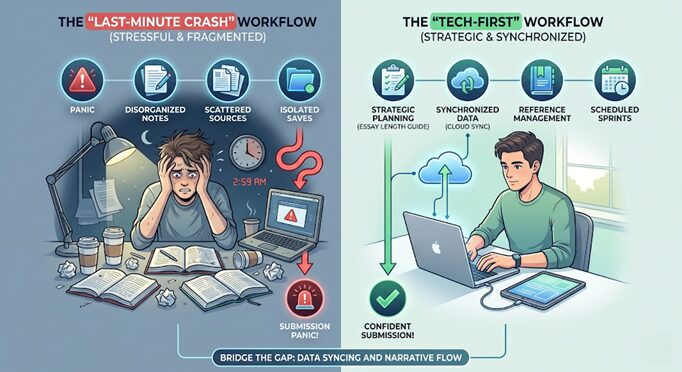
A common mistake is treating the first draft as the final draft. Tech-savvy students use “Sprints”—short, 25-minute bursts of intense writing followed by 5-minute breaks. During these sprints, don’t worry about grammar or perfect phrasing. Just get the ideas from your synchronized notes into the document. The goal is to create a “shitty first draft” that you can later refine.
However, even the most advanced AI grammar checkers can be tone-deaf. They might catch a misplaced comma, but they often miss the subtle nuances of academic voice or the specific requirements of a professor’s rubric.
For high-stakes assignments, many students find that MyAssignmentHelp provides a crucial final step; their professional essay editing service ensures that the transition from a digital draft to a scholarly masterpiece is seamless. Using a human-led review process after your tech-driven drafting phase creates a “double-check” system that catches logic gaps that software simply cannot see.
Overcoming the “Information Overload”
We live in an age of infinite information, which often leads to “analysis paralysis.” You find 50 great sources, and suddenly you’re too overwhelmed to write a single word. To beat this, use the “Rule of Three.” For every major point in your essay, find three high-quality sources, sync them to your cloud folder, and stop.
Limit your browser tabs. Having 40 tabs open is an invitation for your brain to wander. Use “Focus Mode” apps that block social media during your writing sprints. Technology should be your assistant, not your distraction. By narrowing your focus, you allow your “narrative flow” to take over, making the writing process feel less like a chore and more like a puzzle being solved.
The Final 10%: The Polishing Phase
The difference between a “B” and an “A” usually lies in the final 10% of the effort—the proofreading, the formatting, and the flow. After you’ve finished your draft, step away from the screen for at least four hours. Your eyes need to “reset.”
When you return, read your essay out loud. If you stumble over a sentence, so will your professor. Use tech to help here too; use a “text-to-speech” tool to have your computer read your essay back to you. You’ll hear errors that you would never see. This final review ensures that your hard work isn’t undermined by simple typos or awkward phrasing.
Frequently Asked Questions (FAQ)
1. How can I avoid plagiarism while using research tools?
Ans: Always use a citation manager to track your sources the moment you find them. Never “copy-paste” into your main document; instead, summarize the idea in your own words in your notes first.
2. What is the best way to handle a massive word count?
Ans: Break it down into smaller, 300-word sections. It’s much easier to write five short “mini-essays” than one giant 1500-word monster. Use your digital outline to give each section a clear goal.
3. Is it okay to use digital tools for editing?
Ans: Absolutely. Tools are meant to enhance your skills, not replace them. Use software for grammar, but always rely on human insight—whether it’s your own or a professional service—to ensure your argument makes sense.
4. How do I stay motivated when the deadline is far away?
Ans: Set “internal deadlines.” Tell yourself the research must be done by Tuesday and the first draft by Friday. Reward yourself with something non-digital when you hit these milestones.
By integrating these tech-first strategies, you move from a reactive state (panicking at the deadline) to a proactive state (managing a system). The “last-minute crash” becomes a thing of the past, replaced by a streamlined, synchronized, and ultimately more successful academic journey.
About The Author
I am Ruby Walker, a senior content strategist at MyAssignmentHelp dedicated to empowering students through smarter, tech-driven academic practices. With a background in educational psychology and digital literacy, I focus on helping undergraduates move beyond the stress of looming deadlines by mastering synchronized research and advanced writing workflows.