





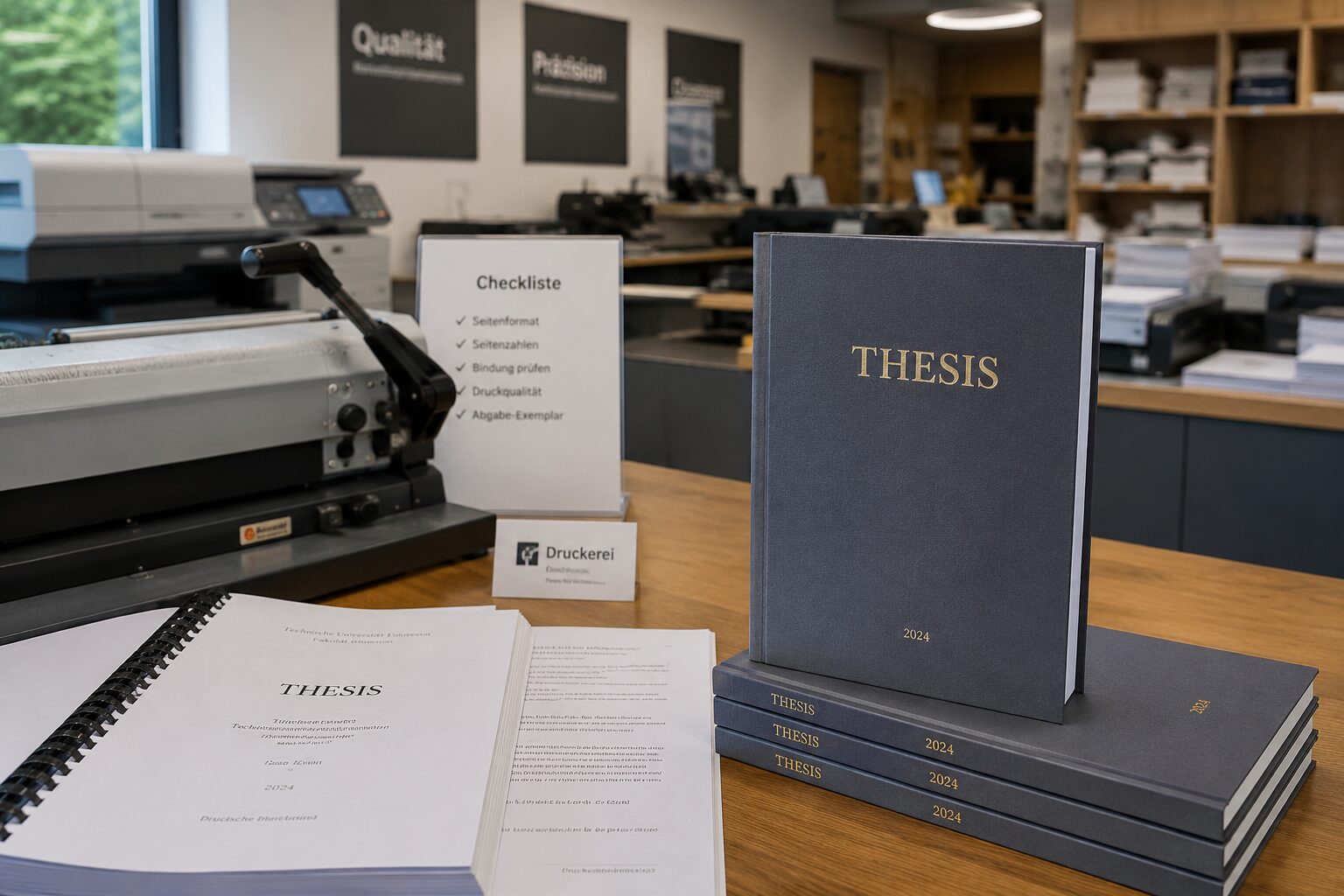
The final months of an academic journey are often a whirlwind of research, data analysis, and late-night writing sessions. Whether you are finishing a Bachelor’s, Master’s, or Doctoral thesis, the culmination of your hard work is a document that represents years of dedication. However, the process doesn’t end when you type the final period. The physical presentation of your work—the printing and binding—is the last hurdle before submission. In Germany, where academic standards are notoriously high, ensuring your thesis looks professional and meets university requirements is crucial. This guide provides comprehensive tips on how to navigate the final stages of your academic project, from formatting to choosing the right binding.
When you reach the final stage of your academic journey, the quality of your printed document can significantly impact the first impression you make on your examiners. A well-bound thesis reflects the care and precision you put into your research. For many students, finding a reliable partner for this task is essential. If you are looking for a professional and efficient way to handle this, you can visit TesiLab to explore high-quality options that cater specifically to the needs of students in Germany. Utilizing a specialized service ensures that your work is treated with the respect it deserves, allowing you to focus on your defense rather than worrying about whether your pages are straight or if the glue will hold.
The Importance of Proper Formatting
Before you even think about the printer, your document must be perfectly formatted. Most German universities have specific guidelines regarding margins, font sizes, and line spacing. Generally, a margin of 2.5 cm to 3 cm on the left side is required to allow for binding, while the right margin is often kept around 2 cm for corrections. Using standard fonts like Times New Roman or Arial in 11pt or 12pt size is typically expected. However, formatting is not just about aesthetics; it is about readability and adhering to academic tradition. A poorly formatted paper can distract the reader from the strength of your arguments, and in some cases, it can even lead to point deductions.
One of the most common mistakes students make is ignoring the “gutter” margin. When pages are bound together, a small portion of the inner margin disappears into the spine. If you don’t account for this, your text might look off-center or be difficult to read near the binding. This is particularly problematic for long theses where the thickness of the paper stack creates a significant curve in the spine. Always check your university’s specific requirements for “Korrekturrand” (correction margin) to ensure your professors have enough space to leave their notes. Furthermore, pay close attention to your page numbering. It is standard practice to have the introductory pages (like the table of contents and list of figures) in Roman numerals, while the main body of the text uses Arabic numerals. Ensuring this transition is seamless in your PDF is a small detail that speaks volumes about your attention to detail.
Master the Art of the Table of Contents and Citations
A thesis is a complex document, and the table of contents is the map that guides your reader through it. It should be clear, concise, and perfectly synchronized with the headings in your text. Modern word processors can generate these automatically, but you must ensure that every heading level is correctly tagged. A common pitfall is having a heading at the very bottom of a page with the text starting on the next page. This “widow” or “orphan” line should be avoided at all costs to maintain a professional flow.
Similarly, your citations and bibliography must be flawless. Whether you are using APA, MLA, Harvard, or a specific German citation style like DIN 1505, consistency is the key. Inconsistent citation is one of the most frequent reasons for negative feedback in academic papers. Tools like Zotero or Citavi can help manage your sources, but a final manual check is always necessary. Make sure that every source mentioned in the text appears in the bibliography and vice versa. This level of meticulousness ensures that your work stands up to the rigorous scrutiny of the German academic system.
Converting to PDF: The Golden Rule
Never send a Word document directly to a printer. Word files are notorious for shifting layouts when opened on different computers. Images might move, fonts might be replaced, and page numbers could get messed up. The only way to guarantee that what you see on your screen is what comes out of the printer is to export your work as a PDF.
When creating your PDF, ensure that all fonts are embedded. This prevents the printing system from substituting your carefully chosen academic fonts with something else. Additionally, check the image resolution. Any diagrams or charts should be at least 300 DPI (dots per inch) to ensure they look sharp in print. A blurry chart can detract from the perceived quality of your data.
Choosing the Right Paper Quality
The tactile experience of your thesis matters. Standard office paper is usually 80gsm (grams per square meter), which can feel a bit thin and allow for “show-through” if you are printing on both sides. For a professional thesis, a weight of 100gsm or 120gsm is highly recommended.
100gsm paper offers a nice balance between thickness and flexibility. It feels substantial in the hand and prevents ink from bleeding through. If your thesis contains many high-resolution color images or complex maps, 120gsm paper provides an even more premium feel and better color reproduction. Some students even opt for “Natural Skin” or eco-friendly paper options, which are becoming increasingly popular in Germany as universities and students alike prioritize sustainability.
Understanding Binding Options
The type of binding you choose often depends on the level of your degree and the requirements of your faculty. Here are the most common types used in German academia:
1.Hardcover Binding: This is the “gold standard” for Master’s and Doctoral theses. It looks like a real book, with a stiff cover that protects the pages for decades. It conveys a sense of permanence and high achievement. Many students choose to have their title and name embossed in gold or silver on the front cover and the spine.
2.Softcover Binding: Also known as “paperback” binding, this is a popular choice for Bachelor’s theses. It is more affordable than hardcover but still looks very professional. The cover is usually a thick cardstock that can be printed with your title.
3.Thermal/Glue Binding: This is a simple and clean option where the pages are glued into a spine with a clear plastic front and a colored back. It’s often used for internal copies or less formal reports.
4.Spiral Binding: While very practical because it allows the document to lie flat, many German faculties do not accept spiral binding for final submissions. Always check your regulations before choosing this.
In the middle of your stressful submission week, you might find yourself searching for a way to Bachelorarbeit drucken lassen without having to leave your desk. Online printing services have revolutionized this process, offering 24-hour production times and direct shipping. This is particularly helpful for students who are working right up until the deadline. By using an online configurator, you can see a live preview of your cover, choose your colors, and get an instant price quote, removing much of the uncertainty from the process.
Color vs. Black and White Printing
Budget is always a concern for students, and printing costs can add up quickly. Most services charge significantly more for color pages than for black and white. To save money, go through your thesis and identify which pages actually need color. Many diagrams can be adjusted to use different shades of gray or patterns instead of colors while remaining perfectly readable.
However, don’t sacrifice clarity for cost. If a map or a complex biological diagram is unreadable in black and white, it is worth the extra few euros to print those specific pages in color. Modern digital printing allows for “mixed” printing, where you only pay the color rate for the pages that actually contain color.
The Finishing Touches: Embossing and Ribbons
If you opt for a hardcover, you have the opportunity to add professional touches that make your work stand out. Embossing (Prägung) is the process of pressing text into the cover. In Germany, it is traditional to include the title of the work, your name, and the university logo. Some premium services even offer this embossing for free as part of their hardcover packages.
Another elegant addition is a bookmark ribbon (Lesebändchen). While it might seem like a small detail, it allows your examiners to easily mark their place. Choosing a ribbon color that matches your university’s colors or your cover choice adds a level of sophistication that doesn’t go unnoticed.
Timing and Delivery
One of the biggest risks in the thesis process is the timeline. You should never plan to print your thesis on the day it is due. Unexpected issues—like a file error, a printer jam, or a shipping delay—can cause a catastrophe.
Ideally, you should have your final PDF ready at least three to four days before the deadline. If you are using an online service, look for those that offer express 24-hour production. In Germany, reliable shipping usually takes 1-2 business days. Many top-tier services offer free shipping across the country, which is a great way to keep your costs down while ensuring your work arrives safely at your doorstep or directly at the university office.
Sustainability in Academic Printing
As environmental awareness grows, many students are looking for ways to make their graduation more “green.” The academic world is increasingly focusing on the environmental impact of its activities, and printing a large volume of papers is no exception. Look for printing services that use FSC-certified paper, which ensures that the wood used for the paper comes from responsibly managed forests. Additionally, many modern printing companies offer CO2-neutral shipping, offsetting the carbon emissions generated during the delivery process.
Some companies even go a step further by partnering with reforestation projects, planting a tree for every order placed. This allows you to celebrate your academic achievement while giving back to the environment. Choosing an eco-friendly printing path is a great way to ensure that your academic achievement doesn’t come at an unnecessary cost to the planet. In Germany, where “Nachhaltigkeit” (sustainability) is a core value, submitting a thesis printed on sustainable materials can also be a subtle way to align your work with broader societal values.
The Role of Professional Proofreading
While you might be an expert on your topic, it is easy to become “blind” to your own mistakes after staring at the same document for months. Professional proofreading is an investment that can pay off significantly. A fresh pair of eyes can spot grammatical errors, awkward phrasing, and logical inconsistencies that you might have overlooked. In the context of a thesis, where precision is paramount, even a single typo on the cover page can undermine your credibility.Z
If a professional editor is outside your budget, consider a peer-review system with your fellow students. Swapping papers and providing feedback can be mutually beneficial. Focus not just on the language, but also on the flow of arguments. Does the conclusion effectively answer the research question posed in the introduction? Are the transitions between chapters smooth? Taking the time for this final layer of polish ensures that the content of your thesis is as impressive as its physical presentation.
Preparing for the “Defense” or Viva Voce
Once your thesis is printed, bound, and submitted, the next step in many German degree programs is the “Verteidigung” or defense. This is your opportunity to present your findings and answer questions from your examiners. Having a physical copy of your thesis with you during the defense can be a helpful reference. It allows you to quickly flip to a specific chart or table when asked a detailed question.
Preparation for the defense should involve creating a clear presentation that highlights the most important aspects of your work. Don’t try to cover everything; instead, focus on your methodology, your key findings, and the implications of your research. Practice your presentation multiple times to ensure you stay within the time limit. Being well-prepared for this final oral exam is the last step in completing your degree with honors.
Dealing with “Thesis Anxiety”
It is completely normal to feel a sense of panic as the deadline approaches. The best way to combat this is through preparation. Double-check your page numbers, ensure your bibliography is in the correct format, and have a friend or a professional editor do a final proofread. Once the content is perfect, the physical act of printing and binding should be the easiest part of the journey.
When you finally hold that bound volume in your hands, the weight of it—both literal and metaphorical—is a powerful feeling. It is the physical manifestation of your intellectual growth. By choosing the right materials and a professional service, you ensure that the physical quality of your work matches the quality of your ideas.
In conclusion, the path to a successful thesis submission involves more than just good writing. It requires attention to detail in the final formatting, a clear understanding of your university’s physical requirements, and the selection of a printing partner that understands the high stakes of academic life. For those in the final stretch, utilizing a specialized platform like tesilab.de can provide the peace of mind needed to cross the finish line with confidence. With their focus on speed, quality, and student-friendly pricing, you can rest assured that your Bachelor’s or Master’s thesis will be a professional document you can be proud of for years to come. Congratulations on reaching this milestone, and good luck with your submission!